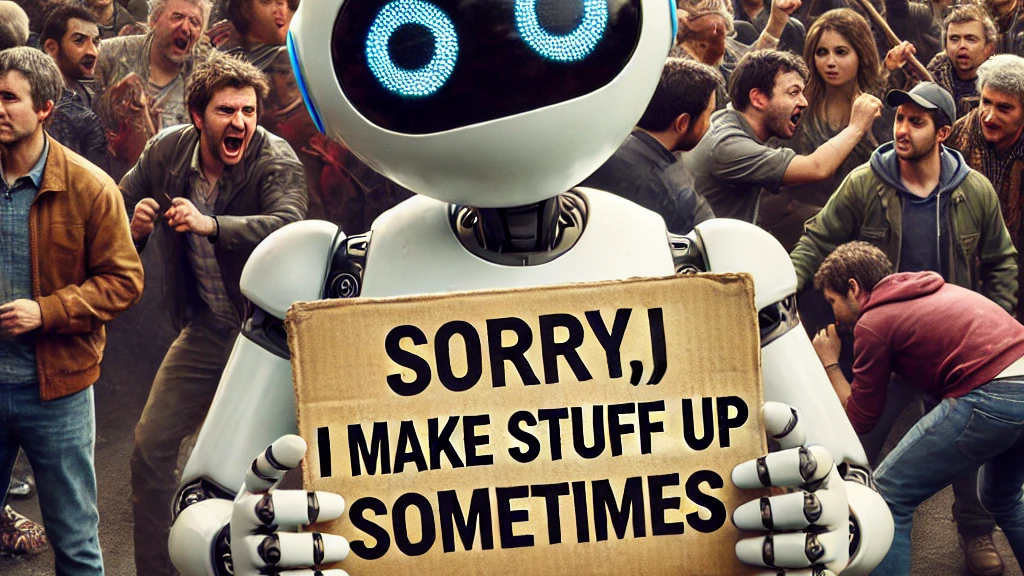
I used to dislike the term hallucination for model errors. It anthropomorphises a statistical system as if it were a tired assistant improvising under pressure. But the core issue is real: predictive language models can generate plausible but incorrect output, especially when prompts create ambiguity or overreach.
This is not simply user error, though good prompting and validation help. It is an architectural consequence of how these systems are built. The model does not know what it does not know — it predicts plausible completions, and when the training data does not provide a clear signal, plausible and accurate can diverge. Telling a model to not make things up is not enough on its own. Better retrieval, grounded search, verification workflows, and stronger evaluation practices reduce the problem, but do not eliminate it entirely.
The Right Critique, and the Wrong One
It is reasonable to demand high reliability from systems used for critical information work. In some contexts, transformer-based approaches may not be the right tool and other methods may be more dependable. That said, dismissing AI entirely because hallucinations exist misses a broader question: when did humans become a flawless benchmark for truth?
Human Error Is Not Rare Either
In recent years, we have seen confident public predictions that aged badly. Not because the speakers were malicious, but because uncertainty, bias, and incomplete information shape human judgement too.
- February 2020: "COVID is not going to be a major issue."
- Post-2021: "Meta is finished."
- 2019: "Nvidia has no meaningful growth left."
People fill knowledge gaps with assumptions all the time. In that sense, humans also generate confident fiction, just with different mechanisms.
The Bigger Risk
The more serious threat may be deliberate human misinformation, especially in political and media ecosystems where distortion is strategic rather than accidental. That is not harmless gap-filling. It is intentional narrative engineering designed to divide, alienate, and manipulate.
Compared with that, model-level errors like occasional fabricated details or text artifacts are technically difficult but tractable. We can improve those systems over time. Rebuilding trust in human information ecosystems may be harder.
Bottom Line
Yes, AI hallucinations matter and should be actively managed. But right now, I am more concerned about high-volume, high-intent human misinformation than I am about a model misspelling a generated sign or miscounting letters in "strawberry."