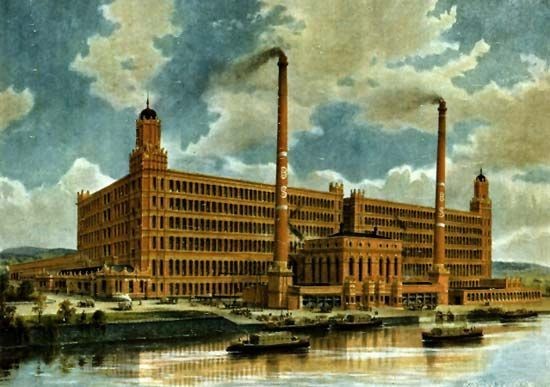
Broadstone Mill in Stockport, built in 1903 and expanded by 1907 to become the largest spinning mill in Europe, stands as a powerful symbol of the transformative changes brought about by the Industrial Revolution.
The mill's history and impact on the surrounding region highlight the significant shifts in technology, economy, and society that characterised this pivotal period in history.
The First Industrial Shift
During the Industrial Revolution, new machines and manufacturing processes transformed the textile industry. The spinning mule and power loom enabled mass production, and large factories such as Broadstone Mill emerged as hubs of industrial activity.
The scale of Broadstone Mill exemplified the unprecedented growth and efficiency of that era. Its presence in Stockport also reflected wider economic and demographic change, as people migrated from rural areas to urban centres in search of factory work. The mill employed hundreds, then thousands, operating machinery that ran day and night, demanding labour patterns that reshaped family life, community structure, and the relationship between employer and worker in ways that took generations to fully reconcile.
Progress and Cost
The growth of Broadstone Mill and similar factories attracted workers from far and wide, turning Stockport and nearby towns into thriving industrial communities. But that growth brought severe social challenges too.
Factory conditions were often harsh, with long hours, low wages, and dangerous machinery. Rapid urbanisation led to overcrowding, poor sanitation, and disease. The contrast between wealth creation and working-class hardship exposed deep social inequality.
A New Revolution in an Old Building
Over time, Broadstone Mill underwent multiple redevelopments as economic conditions changed. Its later use as Mesmerise's development centre is symbolic of the Industrial Revolution's enduring legacy.
A building that once housed Europe's largest spinning mill became a site for a new technological wave driven by virtual reality (VR) and artificial intelligence (AI).
Just as mechanisation reshaped industry in the first revolution, spatial computing and AI now have the potential to reshape entertainment, education, healthcare, manufacturing, and more. The adoption curve may differ, but the scale of change could be comparable. The risk horizon is similarly mixed: efficiency gains and new capability will coexist with disruption to established roles, displacement of existing skills, and social adjustment at a pace that policy and education systems will struggle to match.
While specific outcomes are difficult to predict, we are clearly on the cusp of another era defined by the convergence of advanced technology and human ingenuity.